Pumping, inspection, repair, and full installation across Fuquay-Varina and the surrounding Triangle. Written pricing before the work starts.
Call (555) 555-5555Or call — we answer. No obligation, honest advice.
Fuquay-Varina straddles the Wake and Harnett county line, and that line is the first thing to understand about septic here. Two counties means two health departments and two permitting offices, and a company that only knows one of them is guessing on half the addresses south of town. Out past the sewer lines on Highway 401, along Highway 55, and down toward Willow Spring and Angier where the acreage begins, this is still septic country the way it always has been.
The area mixes brand-new subdivisions off Judd Parkway with farmhouses whose tanks predate the four-lane highways. Both need care, just different care: new systems need correct startup habits, and older systems need honest evaluation before a small issue becomes an excavation project. City-water addresses in downtown Fuquay-Varina do not need us. Nearly everyone on the outskirts and out in the county eventually does.
The process is deliberately unglamorous. We locate the system, open it, photograph the actual condition, and give you a written price before starting. Diagnosis comes first, the quote second, the work third. Sometimes the visit ends with us telling you to spend nothing and call again in a few years.
Most septic work is excavation. Locating a tank, opening a lid, exposing a line, or installing a new field all start with breaking ground, and how that gets done decides what your yard looks like afterward.
Lids get seated properly, ground gets raked back, and no ruts get cut across the yard. The only evidence we were there should be a system that works the way it is supposed to.
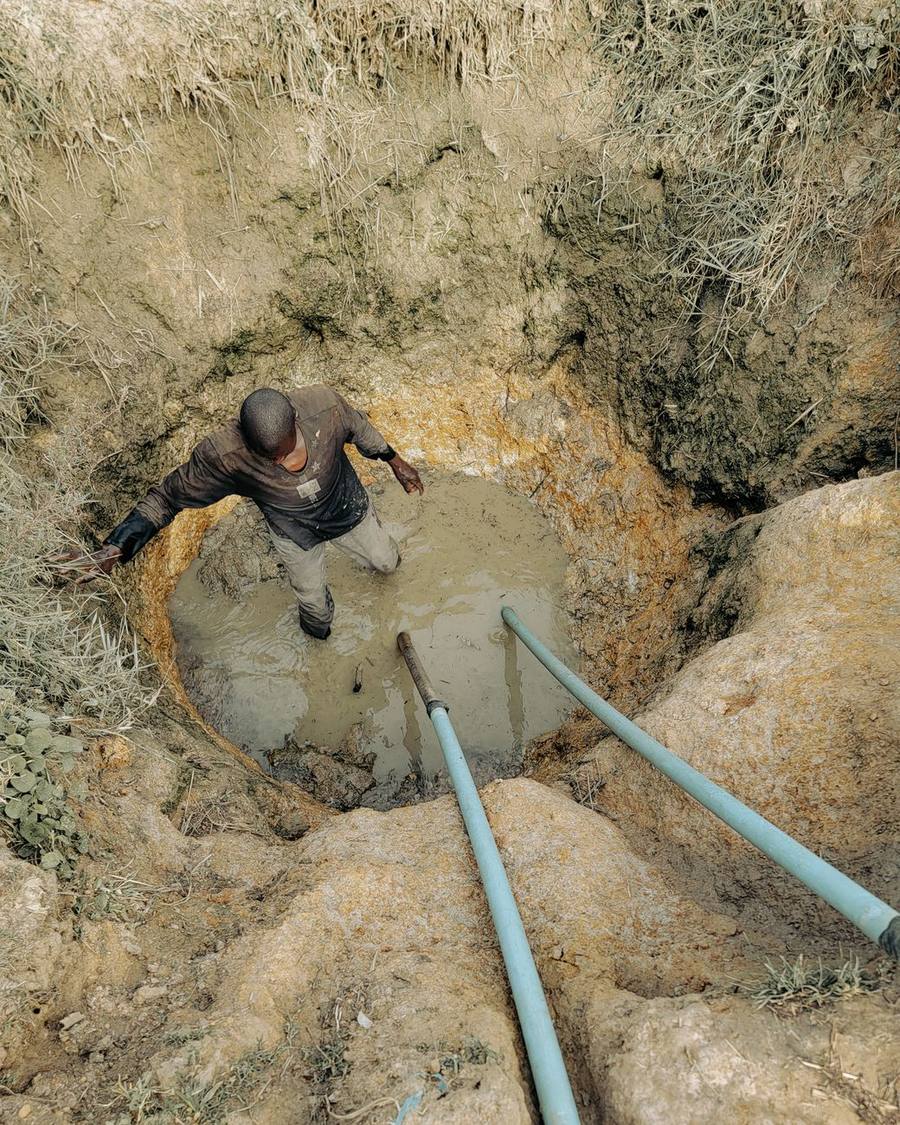
Four services cover almost everything a residential system in southern Wake and northern Harnett needs.
Complete pump-outs on a three-to-five-year cycle. We uncover the lids, pump fully - sludge and scum, not just liquid - inspect the baffles, and hand you a written condition report every time.
Closing-ready reports for buyers and sellers. Tank and sludge levels, baffle and tee integrity, pump and alarm operation, and drain field surface, photographed and clear enough to negotiate with.
New builds and replacements, plus repairs to baffles, pumps, lines and fields. Soil evaluation and permitting through Wake or Harnett County handled.
A tank separates what reaches it into three distinct layers: a floating scum mat of grease and light debris, a sludge blanket of heavier solids on the bottom, and the relatively clear liquid between them that is the only part intended to move on to the drain field. Once the sludge layer grows past the tank's capacity, solids travel out with the liquid, and a field that has taken on solids does not recover.
Soil is the local variable. Southern Wake and northern Harnett run a mix of sandy loam and heavier clay depending on where you are, and the difference decides how fast a field drains and how it has to be sized. That is why North Carolina requires a soil evaluation before a permit is issued, and why two houses a mile apart can end up with completely different system designs.
Timing follows the same reasoning. A small household on a properly sized tank can often reach five years; a full house should book every three. We set the interval from the sludge depth measured on site rather than from a rule of thumb, because household size drives it more than anything else.

Septic systems seldom fail without warning; they fail slowly and then all at once. Behind most emergencies sit years of skipped pumping. The tank's function is to keep solids and release clear liquid, and when solids outgrow the room available, they follow the liquid into the trenches. Nothing sold in a bottle reverses that.
Hence the rule worth keeping in mind: pumping is a small cost and the drain field is a large one. Every pump-out protects the component that is genuinely expensive to replace - and across Wake and Harnett County, where lot sizes have tightened as the area has built out, a replacement field is not always easy to site.
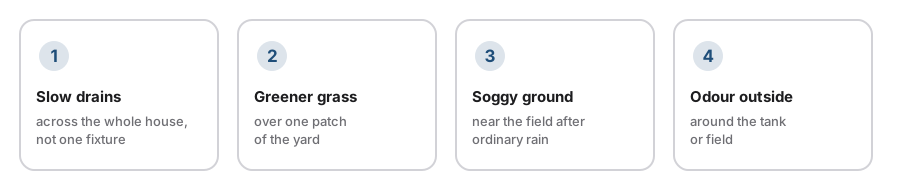
Warnings generally arrive long before failure does. Drains gurgling or slowing across the house rather than at a single fixture. Grass over one section growing noticeably faster. Ground above the field that stays soft after routine rain. An outdoor odor near the tank or trenches. Any of these justifies a look, and a look is the inexpensive option.
Some ordinary habits shave years off a system without anyone noticing. Wipes go down the drain easily and then persist indefinitely. Bleach and drain cleaners used heavily destroy the bacteria the tank relies on. Vehicles crossing or parking on the field compact the ground and break lines. And downspouts or French drains aimed toward the trenches flood a field with clean water it was never sized to handle.
None of these mean disaster on their own. All of them are cheaper to look at than to ignore.
Every job runs the same way, whether it is a routine pump-out or a full installation. Here is the standard you can hold us to.
You get the number before work starts, not after. If we open the lid and find something else going on, we stop, show you, and quote it separately. No surprise line items at the end.
You get a real window and a text or call when the crew is on the way. If weather forces a change, you hear from us first, not last.
Lids seated, ground raked back, no ruts across the yard. The only evidence we were there should be a system that works the way it is supposed to.
Septic is one of the quieter ways a closing falls apart, and around here it is among the most commonly skipped checks. Because a standard home inspection excludes the system, a buyer coming from a sewer-served part of the Triangle can close on an acreage lot with failing trenches and learn about it the first wet week.
Schedule it early enough in the option period that you still have leverage. What gets checked matters as much as the timing: the tank located and opened, sludge and scum measured, baffles and tees confirmed, flow tested with running water, and the trenches probed for saturation. An inspection that skips the field has examined only the inexpensive half.
Sellers get the clearest benefit from acting early. Pumping and inspecting ahead of the listing turns the system into paperwork instead of leverage for the other side. Many buyers here are first-time septic owners, so a clean report answers their biggest worry before they raise it.
Fuquay-Varina is the base, and the service area covers the surrounding communities across southern Wake and northern Harnett County: out along Highways 401 and 55, down toward Willow Spring and Angier, and across the acreage where sewer never reached. Fuquay-Varina is one of the fastest-growing towns in North Carolina, but grow out past the sewer lines and this is still septic country.
Toward the outer edge of the service area, travel is quoted up front and mentioned on the phone rather than appearing later on the invoice. If you sit just beyond the list below, it is still worth calling.

Fuquay-Varina has been one of the fastest-growing towns in North Carolina for years, and the growth has a way of hiding the septic story. New arrivals from bigger cities often assume that a house this new, on a street this developed, must be on sewer. Out past the sewer lines toward Willow Spring, Angier, and the Harnett line, plenty of it is not, and a new owner who has never had a septic system before is exactly the person most likely to let maintenance slide until something backs up.
That is worth saying plainly, because the fix is cheap and the failure is not. A tank pumped on schedule is a routine expense. A field pushed past its limit is a replacement, and on an acreage lot with the wrong soil that is a serious number. If you have just moved out here and inherited a system you have never thought about, the first call costs nothing but a conversation, and it usually ends with a straightforward answer about when, or whether, you need anything at all.
A well-kept septic system is completely uneventful, and that is the whole point. Routine pumping, an inspection before closing, or a full installation - call (555) 555-5555 for a straight assessment, including when the assessment is that nothing is needed yet.
Save the number before you need it. Septic problems only get more expensive the longer they wait.
Tell us what you need and we'll get back to you with a real answer. If it's an active backup or standing water over the field, calling gets you a faster response.
Call: (555) 555-5555
Area: Fuquay-Varina, NC and Wake and Harnett County